 Talking Avatar
AI mock interviews with an interviewer students can see
Give every student a realistic interviewer to practise with, out loud and face to face, as often as they need. It asks your questions for their role, follows up when answers are vague and gives feedback at the end. You set it up in the dashboard, without developers.
- Your questions, by role
- Feedback at the end
- $0.90 per 15-minute interview
- A private link per student
An AI mock interview is a practice interview with an AI that plays the interviewer: it asks questions out loud, listens, follows up and gives feedback. With Talking Avatar Voice Agents, the interviewer is a photorealistic avatar, you write the questions for each role, and every student gets a private link. A 15-minute mock interview costs $0.90, so 500 students practising twice cost $900.
Who it's for
For anyone who helps people get hired
University career centers
Every student practises before the career fair or placement season, not only the ones who get an appointment with an advisor.
Bootcamps and course providers
Behavioral and role-specific rounds at the end of a course, with a transcript your coaches can review.
Career coaches and outplacement firms
Clients practise between sessions with your questions, and you read the transcript before the next one.
Job seekers
Build your own interviewer for the job you applied to. The $1 of free credits covers about 16 minutes of practice.
How it works
From question list to mock interviews in an afternoon
- 1
Start from the Screening interviewer template
Keep its one-question-at-a-time flow, add your questions for the role, and add a feedback section for the end, up to 20,000 characters. Make one agent per role, and add the job description or a question bank as a knowledge base.
- 2
Make it private, with a link per student
Set Who can call to Private, then create a link for each student in the dashboard or from your server, with an expiry, a number of interviews and your own student ID.
- 3
Send the links and read the transcripts
Each interview appears with its transcript and the link it came from. A post-call webhook can send it, with your student ID, to your own system.
# Role & Objective
You are Nadia, a hiring manager running a 15-minute
practice interview for an associate product manager role.

# Interview
Ask these one at a time, in order:
1. Tell me about yourself.
2. Walk me through a time you changed a decision after
   new data came in.
3. How would you prioritise three urgent requests?
4. What questions do you have for me?

# Rules
- Ask one short follow-up if an answer is vague.
- Stay in character during the interview.

# Feedback
When the student says "end interview", step out of
character. For each answer: one strength, one thing to
improve, and whether it covered Situation, Task, Action
and Result. Keep it under two minutes.
# One private link per student, valid for 30 days,
# good for 3 practice interviews
curl -X POST \
https://backend.talking-avatar.dev/api/talking-avatar/voice-agents/AGENT_ID/links \
-H "Authorization: Bearer $TALKING_AVATAR_API_KEY" \
-H "Content-Type: application/json" \
-d '{
"name": "Priya S. - APM practice",
"expiresAt": "2026-12-15T23:59:00Z",
"maxUses": 3,
"metadata": { "studentId": "s_10482" }
}'
# -> { "data": { "url": "https://app.talking-avatar.dev/agent/AGENT_ID?token=..." } }Practise your product manager interview with Nadia,
our AI interviewer. 15 minutes, any time this month:
[your personal link]
Use a quiet room with a microphone. Say "end interview"
when you're done to get your feedback.Example instructions, a private link per student and a message to send. The link's metadata comes back with each interview's webhook, so your system knows whose it was.
What students and advisors get
Practice that feels like the real interview
A realistic interviewer
A photorealistic avatar with lip sync and natural expressions asks the questions out loud, so students practise looking at a face and answering in their own words.
Your questions, role by role
One agent per role or interview type, each with your questions and up to 10 knowledge bases: job descriptions, company notes or a question bank.
Follow-ups and interruptions
It follows up when an answer is vague, and you choose how patient it is, from a calm first round to a brisk final round.
Feedback at the end
Write your checklist into the instructions, and the interviewer steps out of character to tell the student what went well and what to work on.
A private link per student
Links expire when you choose and can be limited to a number of interviews. Your student ID travels with every call, to the webhook and your tools.
A transcript of every interview
Advisors read exactly what each student said, coach from real answers, or send every transcript to their own system.
On screen
What students see
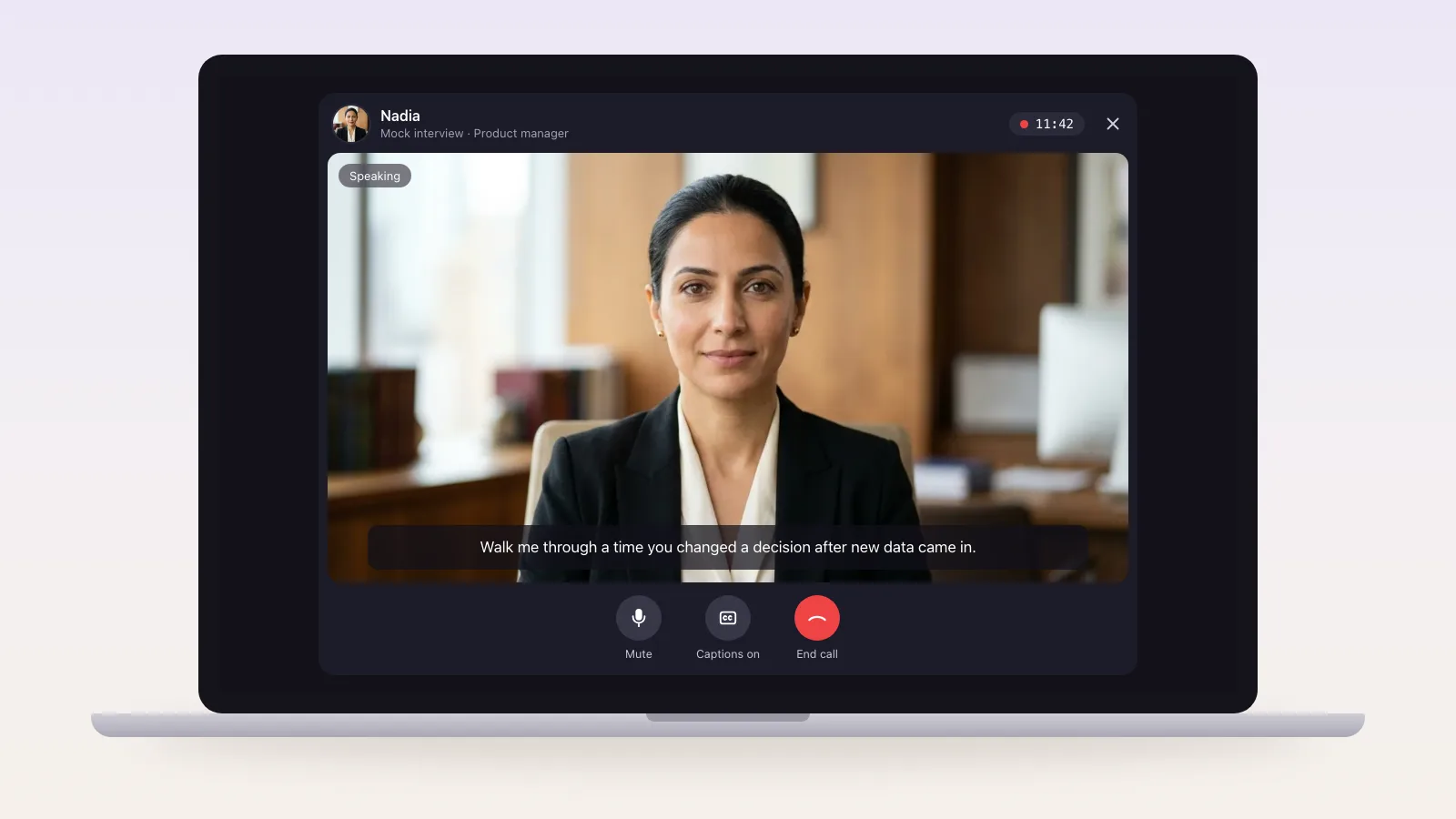
The interviewer's call page, in the student's browser: a realistic person who asks one question at a time, waits for the answer, and follows up when it's vague.
Cost for a cohort
Priced by the minute students practise
The number that matters is minutes, not accounts. These examples assume 2 mock interviews of 15 minutes per student, at $0.06 a minute with the avatar, voice and AI included.
| Students | Minutes of practice | Cost ($0.06/min, all in) |
|---|---|---|
| 100 | 3,000 | $180 |
| 500 | 15,000 | $900 |
| 2,000 | 60,000 | $3,600 |
For comparison, on each vendor's own site on 15 November 2026: Trainexus charges €30 per conversation hour plus VAT, so the same 15,000 minutes for 500 students come to €7,500 plus VAT; InterprepAI's Pro plan is $39 a month per person for 12 interviews; and Huru is free for job seekers, with institutional plans priced on request.
Before you start
What it does, and what it doesn't
It does
- Asks your questions out loud, one at a time, for the role each student is preparing for
- Follows up once when an answer is vague, like a real interviewer
- Steps out of character at the end and gives feedback against your checklist, such as STAR
- Gives each student a private link, so every interview in your dashboard says whose it was (private agents)
- Keeps a transcript of every interview, and sends it to your system with a post-call webhook
It doesn't
- Score answers automatically or show a progress dashboard per student
- Watch the student: it never uses the camera, so there's no feedback on eye contact or body language
- Connect to your LMS or single sign-on
- Give students a coding pad: technical rounds are talked through
Honest fit
When another tool fits better
Students need free practice today, with no setup from you
Huru is free for job seekers, with a ready-made library of interview questions.
You need scorecards, cohort analytics and LMS integration
Dedicated interview-practice platforms for universities sell those, usually per seat and on a quote.
You're hiring, not practising
For screening real candidates with the same questions for everyone and no feedback, see the AI interviewer.
Pricing
$0.06per minute of conversation
Avatar, voice and AI included, billed per second from prepaid credits. No seat licences and no subscription: 500 students practising twice for 15 minutes cost $900. New accounts get $1 of free credits to try it.
What a mock interview costs
| Length | Cost |
|---|---|
| 10 minutes | $0.60 |
| 15 minutes | $0.90 |
| 30 minutes | $1.80 |
Optional: a custom avatar of one of your own advisors, with their signed consent, $199 once.
FAQ
AI mock interview questions
Interview practice is one of several things a voice agent can do. See all voice agent use cases.
What is an AI mock interview?
A practice job interview with an AI that plays the interviewer. It asks questions out loud, listens to the answers, asks follow-ups and gives feedback at the end. With Talking Avatar, the interviewer is a photorealistic avatar, so it feels closer to a video interview than a chatbot.
How much do AI mock interviews cost for a university?
$0.06 a minute of interview, with the avatar, the AI model and the voice included. A 15-minute mock interview costs $0.90: 500 students doing 2 each is 15,000 minutes, or $900. There are no seat licences, so students who don't practise cost nothing.
Does the AI interviewer give feedback?
Yes, at the end, from the checklist you write into its instructions: for example one strength and one improvement per answer, and whether it covered Situation, Task, Action and Result. It doesn't produce an automatic score or a dashboard of each student's progress.
Can each student get their own link?
Yes. Make the agent private and create a link per student, in the dashboard or from your server through the API. Each link can expire on a date you choose, allow a set number of interviews, and carry your own student ID, which comes back with every interview's transcript.
Can we use our own questions and job descriptions?
Yes. Write the questions into the instructions, up to 20,000 characters, and add job descriptions or a question bank as knowledge bases. Make one agent per role or interview type.
Does it watch the student on camera?
No. It never uses the camera: it listens and talks. That means no feedback on eye contact or body language, and nothing on camera to store.
How is this different from the AI interviewer use case?
The AI interviewer is for hiring: it screens real candidates with the same questions in the same order and stays neutral. A mock interviewer is for practice: it can be tougher or gentler, and it gives feedback at the end.
Can it run technical interviews?
It can run the talking parts: behavioral questions, case questions, and talking through a system design or an approach. It has no coding pad or whiteboard.
Which languages can students practise in?
It understands students in their language and replies in it, with 160 voices in 15 languages. Make a test call in each language first.
Who built this?
Talking Avatar is made by InterviewFlowAI, which runs many of its own candidate interviews on these avatars.
Let every student practise before it counts
Start from the Screening interviewer template, add your questions and a feedback checklist, and make a test interview with your $1 of free credits.