 Talking Avatar
Alternatives guide
7 Best Ready Player Me Alternatives in 2026, After the Shutdown
By Mukul Munjal, Co-founder, Talking Avatar · LinkedIn
· Prices checked 30 October 2026
Talking Avatar publishes this guide and is one of the tools listed. Every other entry uses the vendor's own website, docs or repository.
Quick answer
The best Ready Player Me alternative for user-made avatars is Avatar SDK (MetaPerson): a selfie creator that embeds in your app and exports .glb with Oculus-identical visemes, $800 a month for 1,000 avatars as of 30 October 2026. Avaturn is free to start. MPFB, a free Blender add-on, suits avatars your team builds. Talking Avatar Open Source makes exported RPM avatars talk, free.
What is the best Ready Player Me alternative?
Ready Player Me is gone. Netflix announced it was buying the company in December 2025, and RPM's avatar creator, developer APIs and PlayerZero went offline on 31 January 2026. As of 30 October 2026 the readyplayer.me domain doesn't resolve, so hosted avatar URLs and the docs are dead too. Any .glb you downloaded still works. For a creator your users run from a selfie, pick Avatar SDK (MetaPerson) or Avaturn, both $800 a month on Pro for 1,000 avatars. For free avatars your team builds, use MPFB in Blender. To make exported RPM avatars talk in the browser, Talking Avatar Open Source reads their visemes for free.
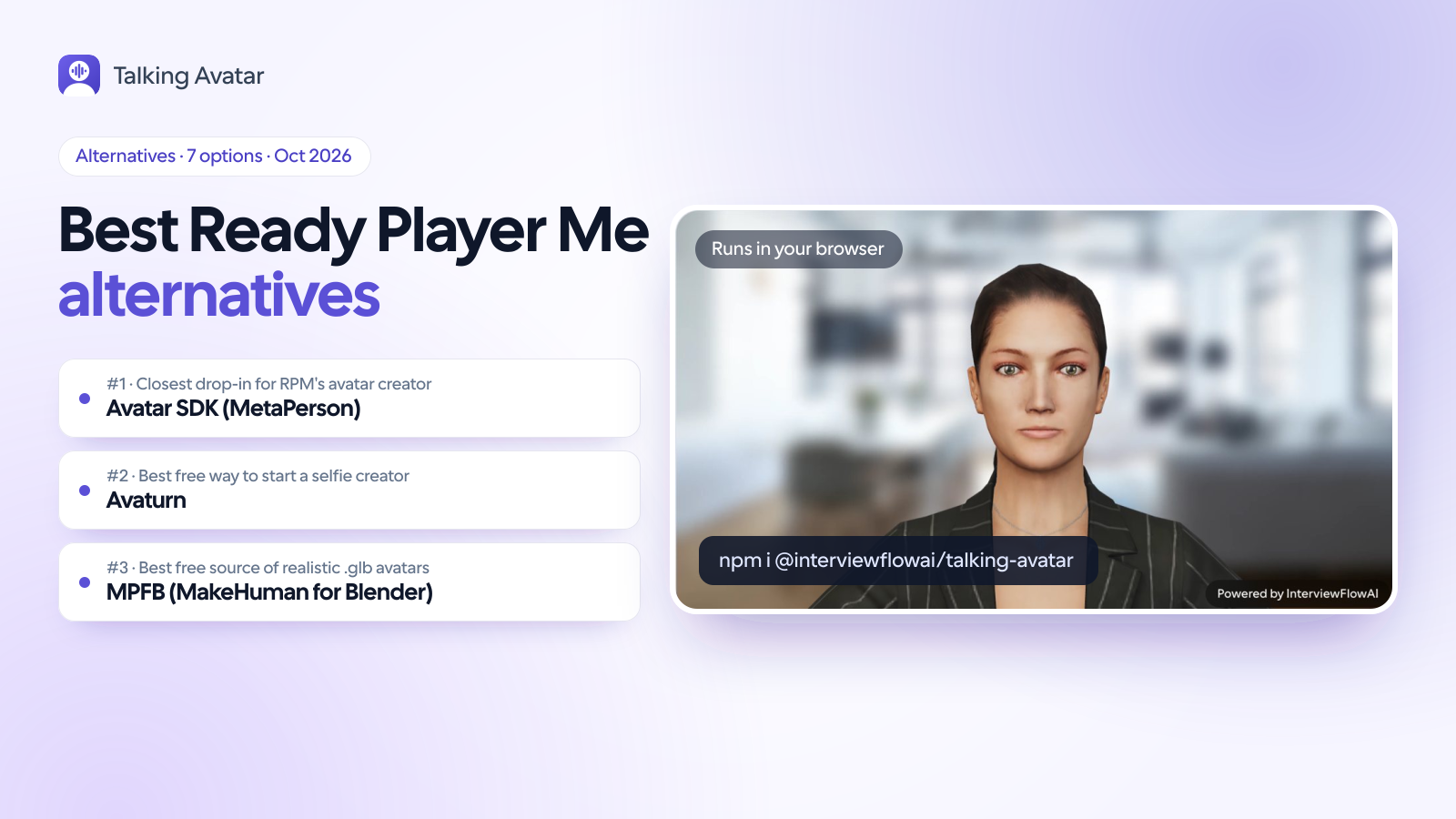
Why teams look for alternatives to Ready Player Me
- It shut down on 31 January 2026
- TechCrunch reported Netflix's acquisition on 19 December 2025. RPM wound down its avatar creator, developer APIs and its newer PlayerZero platform on 31 January 2026.
- Hosted avatars and docs are dead
- As of 30 October 2026 readyplayer.me doesn't resolve, so models.readyplayer.me links, the docs and the demo are gone. Even TalkingHead swapped its RPM demo avatars for a local file in October 2026.
- New users can't make avatars
- Apps that embedded RPM's creator need a new one, and old avatars don't carry over: Avatar SDK says existing RPM avatars can't be imported into MetaPerson.
- Lip sync relied on its morph targets
- RPM avatars could be exported with ARKit and Oculus viseme morph targets, which web lip-sync libraries read. A replacement has to export those shapes too, or you map new names.
What to look for in an alternative
- Who creates the avatar
- Your users from a selfie (MetaPerson, Avaturn, Genies), your team in a desktop tool (MPFB, VRoid, Character Creator), or nobody, with a ready-made face.
- .glb with visemes
- For lip sync on the web, look for .glb export with the 15 Oculus visemes or ARKit blendshapes. VRM's five vowels and FBX exports need extra work.
- Who hosts the files
- RPM hosted your avatars, and that's what broke. Prefer a tool that hands you the file, so the next shutdown can't take your avatars with it.
- Price per avatar and plan limits
- Selfie creators bill per avatar, and their Pro plans cap company size: Avaturn's needs under $1M revenue, MetaPerson's under $2M. Check the plan you'd qualify for.
Ready Player Me alternatives at a glance
| Tool | Who makes the avatar | .glb with lip-sync shapes? | Platforms | Price (30 Oct 2026) |
|---|---|---|---|---|
| Avatar SDK (MetaPerson) | Your users, from a selfie (embedded creator) | Yes: .glb with Oculus-identical visemes; ARKit set via REST API | Web (iframe, Three.js, Babylon.js), Unity, Unreal, iOS, Android | First avatar free; Pro $800/mo for 1,000, then $0.03 each |
| Avaturn | Your users, from a selfie | Yes: .glb with ARKit blendshapes and visemes | Web SDK, Unity, Unreal, iOS, Android | Free integration (Avaturn-branded); Pro $800/mo for 1,000, then $0.15 each |
| MPFB (MakeHuman for Blender) | Your team, in Blender | Yes, with the free Visemes 02 and Faceunits 01 packs | Blender; the .glb works in any engine | Free (GPLv3 code, CC0 assets) |
| Talking Avatar Open SourceOur product | Doesn't create avatars; animates yours | Reads them: any .glb with the 15 Oculus visemes | Browser (three.js), React or plain JavaScript | Free (MIT); hosted Realistic Avatars $0.02/min |
| Genies Avatar SDK | Your users, in Genies' editor | No .glb export; avatars load through the SDK | Unity; Web SDK (Three.js) in early access; iOS, Android | Free, commercial use included |
| VRoid Studio | Your team or users, in a desktop or iPad app | VRM, not .glb; five vowel shapes need mapping | Windows, macOS, iPad; three-vrm on the web | Free (ads on iPad) |
| Character Creator 5 | Your artists, on Windows | No: FBX, OBJ or USD; convert to .glb in Blender | Unreal, Unity, Blender, Maya, iClone | $299 perpetual, or from $99/year |
Monthly cost for 5,000 user-made avatars
Published prices, 30 Oct 2026, billed monthly: Pro fee plus $0.03 (MetaPerson) or $0.15 (Avaturn) per avatar past the 1,000 included. Both Pro plans are for small companies only. Free options keep the vendor's login (Avaturn) or account (Genies).
- Avaturn free integration$0
- Genies Avatar SDK$0
- Avatar SDK (MetaPerson) Pro$920
- Avaturn PRO$1,400
The 7 best Ready Player Me alternatives
1. Closest drop-in for RPM's avatar creator
Avatar SDK (MetaPerson)
itSeez3D's MetaPerson Creator turns a selfie into a rigged, full-body avatar and embeds in your app as an iframe, much as RPM's creator did. It exports .glb, glTF or FBX with a viseme set its docs call identical to Oculus Lipsync (an ARKit-compatible set comes through its REST API) and ships Three.js and Babylon.js loaders. Old RPM avatars can't be imported.
Pricing: First avatar free and a 7-day API trial; Pro $800/month, or about $600/month billed yearly, for 1,000 avatars a month, then $0.03 each (companies under $2M in revenue and under $2M raised); Enterprise quoted.
Best for: Apps where users make a realistic avatar of themselves and you need .glb files with visemes.
2. Best free way to start a selfie creator
Avaturn
Goodsize's web creator turns a selfie into a realistic avatar with a humanoid rig, ARKit blendshapes and visemes, exported as .glb (its guides convert GLB to FBX or VRM). The free integration keeps Avaturn's login and branding; Pro adds your own branding, user management and API. You host the exported files, and TalkingHead users report that its T2 export carries Oculus-named visemes.
Pricing: Basic integration free; Pro $800/month (up to 1,000 avatars, then $0.15 each), for startups founded after 2021 with under $1M revenue; Enterprise custom.
Best for: Startups that want users to make realistic avatars, starting at $0.
3. Best free source of realistic .glb avatars
MPFB (MakeHuman for Blender)
The MakeHuman community's free Blender extension for building realistic human characters. With its Visemes 02 and Faceunits 01 asset packs it exports a .glb with Oculus-style visemes and ARKit-style face units. TalkingHead's maintainer recommends it as a license-clean RPM replacement and documents the export. Your team builds each avatar; end users don't.
Pricing: Free. Code GPLv3, bundled assets CC0, and MakeHuman claims no rights over what you export (check each extra asset pack's terms).
Best for: Teams that need a handful of realistic, license-clean avatars for a web app.
4. Best for making exported RPM avatars talkOur product
Talking Avatar Open Source
Talking Avatar Open Source turns your own 3D .glb avatar into a talking avatar in the browser, animated from any audio stream by a 1 MB neural model: no server, no API key, and the audio never leaves the page. It plugs into OpenAI Realtime, LiveKit, Pipecat or any TTS with one call. (Talking Avatar's photorealistic avatars are a separate hosted product, Talking Avatar Realistic Avatars.)
Why it fits here
- Loads the .glb files you exported from RPM and drives their Oculus viseme morph targets as they are
- Lip sync from any audio in the browser: OpenAI Realtime, LiveKit, Daily/Pipecat or a TTS clip, with no server or API key
- A 1 MB model and about 10 KB of gzipped code, with natural blinks and brows on top of lip sync
- Maps other morph names with the morphTargets option, so avatars from MPFB, MetaPerson or Blender can work too
Pros
- Your existing RPM .glb files keep working, and now they talk
- Nothing to depend on at runtime: host the model and avatars yourself, and no vendor shutdown can break them
- Free for commercial use under MIT, at any number of users
Cons
- It doesn't create avatars: pair it with a creator such as MetaPerson, Avaturn or MPFB
Pricing: Free for commercial and noncommercial use (MIT license).
Best for: Developers putting a 3D face on a voice agent they already run.
5. Closest to RPM's cross-app avatars, for Unity
Genies Avatar SDK
A free avatar system with wearables and an inventory that follows the user across apps, the closest thing left to RPM's cross-game avatars. The main SDK is for Unity (iOS, Android and Windows builds); a Three.js Web SDK is in early access with a token from Genies. Avatars load through the SDK, not as .glb files you keep, and players need a Genies account.
Pricing: Free, including commercial use (Genies account and API key required; end users need a Genies account too).
Best for: Unity games that want a ready avatar, wearables and item system.
6. Best free anime-style avatar creator
VRoid Studio
pixiv's free Windows, macOS and iPad app for anime-style characters, exported as VRM 0.0 or 1.0 and loaded on the web with three-vrm. VRM defines five vowel mouth shapes (aa, ih, ou, ee, oh) and no consonants, so p, b and m get no closed-lip pose, and the vowels need mapping to Oculus viseme names.
Pricing: Free; you set the terms for models you make. The iPad app shows ads (VRoid Plus removes them), and pixiv says ad banners are coming to the desktop version too.
Best for: Anime-style characters and VTuber-style projects.
7. Best for detailed custom characters (desktop)
Character Creator 5
Reallusion's Windows app for detailed, rigged characters, now at CC5.2, with the Headshot 3 plugin for photo-to-head and a facial profile that drives ARKit-style expressions and visemes. It exports FBX, OBJ or USD, not glTF, so web use means converting to .glb in Blender, and forum users report renaming shapes to match ARKit.
Pricing: $299 perpetual license, or Character Creator 365 from $99 a year (CC 365 Pro $399 a year); 30-day free trial.
Best for: Studios building bespoke characters for games and film.
Realistic Avatars and Open Source
The two versions of Talking Avatar
Talking Avatar comes in two separate versions. Talking Avatar Realistic Avatars is a hosted, paid service of ready-made photorealistic avatars, rendered on our servers and streamed to your page over WebRTC or into your LiveKit room (with a LiveKit Agents plugin for Python), for $0.02 a minute. Talking Avatar Open Source is a free, MIT-licensed 3D talking avatar for the browser: it renders a built-in female or male 3D avatar, or your own .glb, and animates its face from any audio (lip sync from a 1 MB model, plus natural blinks and brows), with no server, account or API key, free for commercial and noncommercial use. Both are driven by your own voice agent: OpenAI Realtime, LiveKit, Pipecat or any TTS. No voice agent yet? Talking Avatar Voice Agents run the whole conversation on a realistic avatar, with no code, for $0.06 a minute.
Talking Avatar Realistic Avatars
$0.02 / minHosted, ready-made photorealistic avatars that speak your voice agent's audio in real time, with lip sync, natural expressions and subtle head motion. Rendered on our servers and streamed to your page over WebRTC or into your LiveKit room, from the Node.js SDK, our LiveKit Agents plugin for Python, or a WebSocket API that works in any language.
- $1 of free credits when you sign up
- Billed per second, commercial use included
- No subscription, setup fee or minimum
- Sessions up to 3 hours each
- Ready-made avatars; custom avatars $199 one time
Talking Avatar Open Source
FreeA 3D talking avatar that runs entirely in the user's browser: it renders a built-in female or male avatar, or your own .glb, and animates its face from your agent's audio, with lip sync from a 1 MB model plus natural blinks and brows. No server, no API key, and the audio never leaves the page.
- Free for commercial and noncommercial use (MIT)
- npm install @interviewflowai/talking-avatar
- Source on GitHub
Make your exported RPM avatars talk
If you kept the .glb files you exported from Ready Player Me, host them yourself and load them in Talking Avatar Open Source. It needs the 15 Oculus viseme morph targets, which RPM could include at export. Open a file in Blender or a glTF viewer and look for names like viseme_aa.
- Collect the .glb files you downloaded. Anything you only had as a models.readyplayer.me URL is gone, since the domain no longer resolves.
- Check each file for the viseme_sil to viseme_U morph targets. If they're missing, add them in Blender, or rebuild the avatar in MPFB, MetaPerson or Avaturn.
- Host the files on your own storage or CDN, with CORS allowed for your site.
- Point Talking Avatar Open Source at the file and pass it your voice agent's stream or a TTS clip, as below.
import { TalkingAvatar } from "@interviewflowai/talking-avatar";

const avatar = new TalkingAvatar({
  container: document.getElementById("avatar"),
  avatarUrl: "/avatars/my-rpm-avatar.glb", // your exported RPM .glb, self-hosted
});

avatar.speak("/hello.mp3"); // or avatar.attachStream(agentAudioStream)
The open-source SDK frames a head-and-shoulders close-up; full-body animation stays with your engine.
Recommendations by use case
- Users make realistic avatars from a selfie, under your brand: Avatar SDK (MetaPerson). Past 1,000 avatars a month it charges $0.03 each, against Avaturn's $0.15.
- Users make avatars and the budget is $0: Avaturn's free integration, with its login and branding.
- A few realistic avatars with visemes, built by your team for free: MPFB in Blender, following TalkingHead's export guide.
- Make existing RPM avatars talk on the web: Talking Avatar Open Source (free), or TalkingHead if you want full-body gestures.
- Cross-app avatars and wearables in a Unity game: Genies Avatar SDK.
- Anime-style characters: VRoid Studio.
- Detailed characters built by artists: Character Creator 5, or MetaHuman if you build in Unreal.
- A realistic face with no 3D at all: Talking Avatar Realistic Avatars, $0.02 a minute, with ready-made avatars or a custom avatar of a real person ($199 one time).
How we ranked these tools
We ranked tools by how well they replace what developers used Ready Player Me for: making an avatar, getting a .glb file you control, and giving it a face that can talk. Facts come from each vendor's site, docs or repository, checked on 30 October 2026, and from press coverage of RPM's shutdown. We left out MetaHuman (built for Unreal, no official .glb export), Union Avatars (its site didn't load when we checked) and in3D (the same company as Avaturn). We built Talking Avatar Open Source; it makes avatars talk rather than creating them, so it ranks fourth.
Frequently asked questions
Did Ready Player Me shut down?
Yes. TechCrunch reported Netflix's acquisition of Ready Player Me on 19 December 2025, and RPM shut down its avatar creator, developer APIs and PlayerZero platform on 31 January 2026. As of 30 October 2026 the readyplayer.me domain doesn't resolve, so its docs and hosted avatar URLs are offline too. Its Unity SDK repository is archived on GitHub.
Do my Ready Player Me avatars still work?
.glb files you downloaded still work as ordinary 3D assets if you host them yourself. Anything loaded from RPM's servers, such as a models.readyplayer.me URL, no longer does, and Avatar SDK says RPM avatars can't be imported into MetaPerson. If all you have is the URL, the avatar is gone and needs remaking.
What is the best free Ready Player Me alternative?
For avatars your users make, Avaturn's free integration has no stated cap on avatars or exports, but keeps Avaturn's login and branding and asks you to credit it. For avatars your team makes, MPFB is free, open source and exports .glb with Oculus-style visemes and ARKit-style face units. VRoid Studio is free for anime-style VRM characters.
Which Ready Player Me alternatives export .glb with visemes?
Avatar SDK (MetaPerson) exports .glb with a viseme set its docs call identical to Oculus Lipsync, plus an ARKit-compatible set through its REST API. Avaturn exports .glb with ARKit blendshapes and visemes. MPFB does both with two free asset packs. VRoid exports VRM with five vowels, and Character Creator exports FBX that you convert in Blender.
Can Ready Player Me avatars still lip sync?
Yes, if your export included the Oculus viseme morph targets, which RPM offered as an export option. Talking Avatar Open Source reads them to lip sync the avatar from any audio in the browser, free under MIT, and TalkingHead reads them too and adds full-body gestures. Without those shapes, add them in Blender or map other mouth morphs.
Why isn't MetaHuman on this list?
MetaHuman is Epic's photoreal character creator, free under $1 million in annual revenue, and since version 5.8 its RigLogic and DNA libraries are open source (MIT). We left it off because it's built for Unreal Engine, its faces run on a control rig rather than ARKit or Oculus blendshapes, and there's no official .glb export.
What replaces Ready Player Me in Unity?
Genies Avatar SDK is the closest fit for Unity games: free, with wearables and an inventory that follows players across apps, and its docs include an RPM migration guide. If you want selfie-made realistic avatars as files instead, Avatar SDK (MetaPerson) and Avaturn both ship Unity integrations.
The bottom line
Ready Player Me is gone, and so is every avatar that lived only on its servers. The lesson for the replacement: keep the files. Avatar SDK (MetaPerson) is the closest swap for an in-app selfie creator, Avaturn the cheapest way to start, and MPFB the free route when your team makes the avatars. Whichever you pick, export .glb with Oculus visemes and host it yourself; Talking Avatar Open Source will make it talk in the browser for free.

About me
Mukul Munjal
Co-founder, Talking Avatar
I'm Mukul Munjal, co-founder of Talking Avatar. I have 7 years of experience in engineering, 3 of them building voice agents, and I handle the optimisation of our voice agents. We built Talking Avatar to give our own AI interviewers a face.
Test your old RPM avatar in the 3D demo
Upload an exported Ready Player Me .glb and talk into your mic: if it has Oculus visemes, the mouth moves. Then npm install and ship it, free under MIT, with no account, API key or avatar server.