 Talking Avatar

Comparison guide
Spatius vs Talking Avatar: Price, On-Device Rendering and Limits
By Mukul Munjal, Founder, InterviewFlowAI Pricing verified 30 October 2026
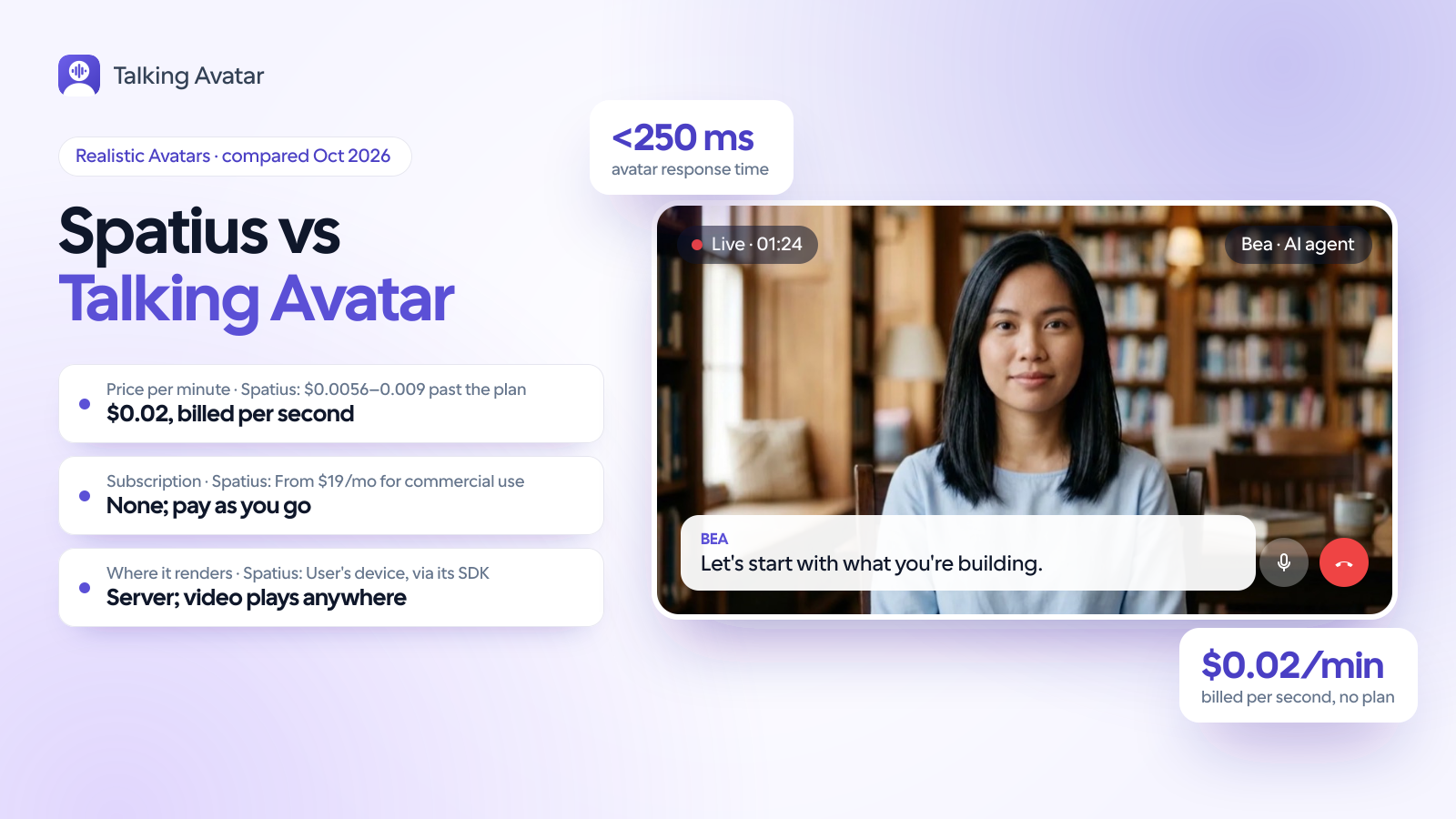
Spatius is a real-time avatar SDK that renders the avatar on the user's device from motion data. As of 30 October 2026 it costs $19 a month for 2,000 minutes (or $189 a year), then $0.007–0.009 a minute, or $0.0056–0.0072 on annual plans; the Free plan's 100 minutes are non-commercial. Talking Avatar Realistic Avatars streams server-rendered video for $0.02 a minute, with no subscription.
60-second comparison
The decision at a glance
Spatius costs less than we do past about 950 minutes a month: $0.0056–0.009 a minute past its plan, against our $0.02 (as of 30 October 2026). It gets there by rendering the avatar on the user's device from a 10–15 KB/s motion stream, so each device downloads a 5–10 MB avatar and renders it, and your app must use its AvatarKit SDK. Talking Avatar Realistic Avatars renders on our servers and sends video, which plays wherever WebRTC does and is a normal video track in LiveKit, with no plan. Volume, devices and how you show the avatar decide it.
Choose Talking Avatar Realistic Avatars if…
- You use under about 950 minutes a month, or your volume swings, and you'd rather not subscribe to use it commercially.
- The avatar must play on any device: we render on our servers, so a phone or old laptop only plays a video stream.
- On LiveKit, you want a normal video track that any LiveKit client can show, not black frames.
- Many people talk at once or calls run long: no concurrency cap and sessions of up to 3 hours.
- Your LiveKit agent runs on Node.js, where Spatius's LiveKit plugin isn't available.
- You have no voice agent: Spatius doesn't offer one, and Voice Agents cost $0.06 a minute with the LLM, speech and voice.
Choose Spatius if…
- Your volume is steady above about 1,000 minutes a month, where $0.0056–0.009 a minute is a quarter to half our rate.
- Your users are on weak or metered networks: a motion stream of 10–15 KB/s instead of a video stream.
- You want custom avatars from one image included in the plan (2 to 40 a month) instead of $199 each.
- You build native iOS, Android or Flutter apps, or use Agora Convo AI or the TEN Framework.
- You want the avatar over your own scene: AvatarKit renders it on a transparent background.
- You need a published enterprise price with a monthly cap, or a region in Beijing or Tokyo.
Feature comparison
| Feature | Talking Avatar Realistic Avatars | Spatius |
|---|---|---|
| Price per minute | $0.02, billed per second | $0.0075–0.0095 on included minutes; extra minutes $0.007–0.009, or $0.0056–0.0072 on annual plans |
| Plans | None: prepaid credits, no subscription | Free; Starter $19, Builder $49, Growth $149, Scale $299 a month for 2,000 to 40,000 minutes; annual billing saves 20% |
| 1,000 minutes a month | $20 | $19 (Starter, monthly) |
| 10,000 minutes a month | $200 | $89.50 (Builder: $49 plus 4,500 minutes at $0.009) |
| Billing unit | Per second, no minimum per session | 10 credits a minute; rounding and per-session minimum not published |
| Free option | $1 of credits once (50 minutes), commercial use allowed | 100 minutes a month, 2 sessions at once, 10-minute calls, public avatars; not for commercial use |
| Sessions at once | No cap, same price per minute | 2, 4, 8, 22 or 40 (Free to Scale); from 80 on Enterprise |
| Longest session | 3 hours | 10, 30, 60 or 120 minutes; no limit on Scale |
| Where the avatar is drawn | On our servers; video reaches the viewer over WebRTC | On the user's device (WebGPU or WebGL on the web) from a motion stream of about 10–15 KB/s |
| What the viewer's device does | Plays a video stream, like any video call | Downloads a 5–10 MB avatar, then renders it; the SDK includes a check for whether the device can run it |
| LiveKit | The avatar joins your room with a normal video track any LiveKit client can show; Node.js SDK, or our WebSocket API from Python or any language | livekit-plugins-spatius (Python only); its video track is black frames carrying motion data, so viewers need Spatius's Web SDK |
| Client platforms | Any browser or app that plays WebRTC or LiveKit video; our browser component for web pages | AvatarKit for Web, iOS, Android and Flutter; Agora Convo AI and TEN Framework integrations |
| Avatars | A growing library of ready-made photorealistic avatars; custom avatar $199 one time | Public avatars, or your own from one image: 2, 4, 14 or 40 creations a month on paid plans, extra $16–25 each |
| Enterprise | Custom quote, as low as $0.005 a minute | From $699 a month for 80 sessions and 80,000 minutes, then $0.005; never more than $5,200; 99.5% availability |
2,000 minutes a month: how peak concurrency sets the bill
Published prices as of 30 October 2026, monthly billing. Spatius: the cheapest plan whose concurrent-session limit covers the peak (2,000 minutes fit every paid plan). Realistic Avatars: 2,000 × $0.02, any number of sessions at once. Longer calls also push Spatius up: 30 minutes on Starter, 60 on Builder, 120 on Growth.
- Spatius Starter, 4 at once$19
- Realistic Avatars, no cap$40
- Spatius Builder, 8 at once$49
- Spatius Growth, 22 at once$149
- Spatius Scale, 40 at once$299
How much does Spatius cost?
As of 30 October 2026, Spatius sells monthly plans: Starter at $19 for 2,000 minutes, Builder at $49 for 5,500, Growth at $149 for 18,000 and Scale at $299 for 40,000. That is $0.0095 to $0.0075 a minute. Annual billing saves 20%: Starter is $189 a year. A minute uses 10 credits, and paid plans keep running past their minutes at $0.009 a minute ($0.007 on Scale), or $0.0072 and $0.0056 on annual plans. Spatius advertises "$0.42 per hour", the Scale rate for extra minutes; ours works out to $1.20 an hour. Enterprise starts at $699 a month for 80 sessions at once and 80,000 minutes, then $0.005 a minute, and never costs more than $5,200 a month. The Free plan's 100 minutes a month exclude commercial use. Spatius marks its pricing as beta: "pricing and limits may change".
When is Spatius cheaper than Talking Avatar?
At steady volume, almost always. $19 buys 950 minutes from us, so past about 950 minutes a month Spatius Starter costs less. 10,000 minutes cost $200 on Talking Avatar Realistic Avatars and $89.50 on Spatius Builder ($49 plus 4,500 minutes at $0.009), or about $71 billed annually. We cost less in three cases. Light commercial use: under about 950 minutes a month, our per-minute price beats any subscription. Peaks: Starter allows 4 sessions at once, Builder 8, Growth 22 and Scale 40, so a class of 15 students practicing at the same time needs Growth at $149 even for 2,000 minutes, which cost $40 on our side. Long calls: Starter ends sessions at 30 minutes, so 45-minute interviews need Builder and 90-minute tutoring needs Growth; ours run up to 3 hours. At very high volume both sides quote: our enterprise and high-volume contracts go as low as $0.005 a minute, and Spatius Enterprise charges $0.005.
On-device rendering: what it changes for your users
Spatius doesn't stream video. Its Motion Server turns your agent's speech into motion data, about 10–15 KB a second, and AvatarKit draws a 3D Gaussian-splatting avatar on the user's device, with WebGPU in Chrome and Edge and WebGL elsewhere. That is why it costs so little and uses so little bandwidth. The device pays instead: it downloads the avatar, about 5–10 MB, before the first frame (later loads can come from cache), and renders every frame. The SDK includes a benchmark, isDeviceSupported(), to check whether a device can run it, and web builds need WebAssembly set up in Vite or Next.js. Talking Avatar Realistic Avatars renders on our servers and sends video over WebRTC, so the viewer's device only plays a video stream, like any video call, and nothing ships in your app bundle. Our avatar starts speaking less than 250 ms after your agent's audio reaches our servers; Spatius publishes no comparable figure.
Spatius with LiveKit: a black video track and a client SDK
Spatius has a LiveKit Agents plugin, livekit-plugins-spatius, for Python; LiveKit's docs list no Node.js version. The plugin sends your agent's speech to Spatius and publishes audio and motion data into the room. LiveKit's own docs explain the catch: the avatar's video track carries motion data in otherwise black frames, so a standard video renderer, including the Agent Console and the LiveKit Playground, shows a black screen. Your frontend has to run Spatius's SDK, and its packaged LiveKit client is web only; on iOS and Android you supply the LiveKit provider yourself. Talking Avatar Realistic Avatars joins your room as an ordinary participant with a video track and a voice track, so any LiveKit client shows it, on the web, iOS, Android, Flutter or React Native. You start it from our Node.js SDK with a publish-only token you mint, or from Python or any other language through our realtime WebSocket API.
Avatars, platforms and enterprise terms
Spatius avatars come from its public library or from one image in Spatius Studio. Paid plans include 2, 4, 14 or 40 avatar creations a month, and extra creations cost $25 each, down to $16 in a pack of 500. AvatarKit renders the avatar on a transparent background, so it can sit over your own image, video or 3D scene. Spatius runs in US West, Tokyo and Beijing; Enterprise lets you choose the region and adds 99.5% availability with service credits and a DPA on request. Talking Avatar Realistic Avatars offers a growing library of ready-made photorealistic avatars, and a custom avatar of your own presenter costs $199 once, made from a short video and voice recording with their consent, and it works in the API and in Voice Agents. Spatius's FAQ says it doesn't provide a voice agent. We sell two ways in: Realistic Avatars for the agent you already run, and Talking Avatar Voice Agents, built in our dashboard, at $0.06 a minute with the LLM, speech recognition and voice included.
When to choose Spatius
Where Spatius is the better fit
Spatius costs less than we do at steady volume, by a wide margin. Past about 950 minutes a month its plans beat our $0.02, and extra minutes cost $0.0056–0.009, between a quarter and a half of our rate. Because the user's device draws the avatar, the network carries a motion stream of about 10–15 KB/s instead of video, which suits weak or metered connections. AvatarKit renders on a transparent background, so you can place the avatar over your own scene, and it ships native SDKs for iOS, Android and Flutter plus Agora Convo AI and TEN Framework integrations. Paid plans include 2 to 40 custom avatars a month, where we charge $199 each, and Enterprise has a published price and cap.
Switching from Spatius
Spatius and Realistic Avatars both take your agent's speech, so switching changes how the face reaches the viewer and keeps the agent. The bigger change is on the client: AvatarKit comes out.
- Create a Talking Avatar Realistic Avatars account (it comes with $1 of free credits), create an API key and pick an avatar ID from the library, or order a custom avatar for $199.
- In your LiveKit worker, remove spatius.AvatarSession and keep the agent's speech recognition, LLM and TTS.
- Mint a publish-only LiveKit token for the avatar and start the session with it, from our Node.js SDK or, for a Python worker, through our realtime API (our docs have a complete Python example).
- Send your agent's TTS audio to the session as PCM16 at its native rate (8 to 48 kHz). The avatar publishes the voice in sync with its lips, so don't also play the agent's own voice track.
- In your frontend, replace AvatarKit and its WebAssembly build setup with a plain LiveKit video element, or our browser component if you don't use LiveKit.
- Run both on the same agent for a week and compare cost and how the avatar looks on your users' slowest devices before you cancel the Spatius plan.
Methodology
How we evaluated this comparison
Pricing and features come from each vendor's own website, documentation or source code, checked in October 2026 and dated on this page. Where a vendor doesn't publish something, we say so rather than guess. We haven't run paid trials of every product. We built Talking Avatar, so we name what each competitor does better and who should choose it instead.
About the author: Mukul Munjal is the founder of InterviewFlowAI, which built Talking Avatar to give its AI interviewers a face. He writes about real-time avatars and lip sync for voice agents.
Frequently asked questions
How much does Spatius cost?
As of 30 October 2026, Spatius costs $19 a month for 2,000 minutes (Starter), $49 for 5,500 (Builder), $149 for 18,000 (Growth) and $299 for 40,000 (Scale), or 20% less billed annually. Extra minutes cost $0.009 ($0.007 on Scale), or $0.0072 and $0.0056 on annual plans. Enterprise starts at $699 a month for 80,000 minutes and never exceeds $5,200.
Is Spatius free?
For testing, yes. The Free plan gives 100 minutes a month with 2 sessions at once, 10-minute calls and public avatars, but it doesn't allow commercial use, so a live product needs a paid plan from $19 a month. Talking Avatar Realistic Avatars gives $1 of credits once (50 minutes), and commercial use is included from the first minute.
Is Spatius cheaper than Talking Avatar?
Yes, at steady volume. Past about 950 minutes a month Spatius Starter beats our $0.02 a minute, and 10,000 minutes cost $89.50 on Spatius Builder against $200 with us. Talking Avatar Realistic Avatars costs less for light commercial use, when more people talk at once than your Spatius plan allows, or when calls run longer than its plan's limit.
How does Spatius render avatars?
On the user's device. Spatius's Motion Server turns your agent's speech into motion data, about 10–15 KB a second, and its AvatarKit SDK draws a 3D Gaussian-splatting avatar locally, with WebGPU or WebGL on the web and native SDKs on iOS, Android and Flutter. Each avatar is a 5–10 MB download that must finish before it can render.
Does Spatius work with LiveKit?
Yes, through livekit-plugins-spatius for Python LiveKit Agents. LiveKit's docs note that the avatar's track is black frames carrying motion data, so it won't show in the Agent Console, the Playground or a standard video renderer; your frontend must run Spatius's SDK, whose packaged LiveKit client is web only. Talking Avatar Realistic Avatars publishes an ordinary video track instead.
Does Spatius include a voice agent?
No. Spatius's FAQ says your voice platform owns the microphone, turn-taking, speech recognition, LLM and speech generation; Spatius only animates the audio it receives. Talking Avatar Realistic Avatars also work with the agent you already run, and if you don't have one, Talking Avatar Voice Agents include the LLM, speech recognition and voice for $0.06 a minute, built in our dashboard with no code.
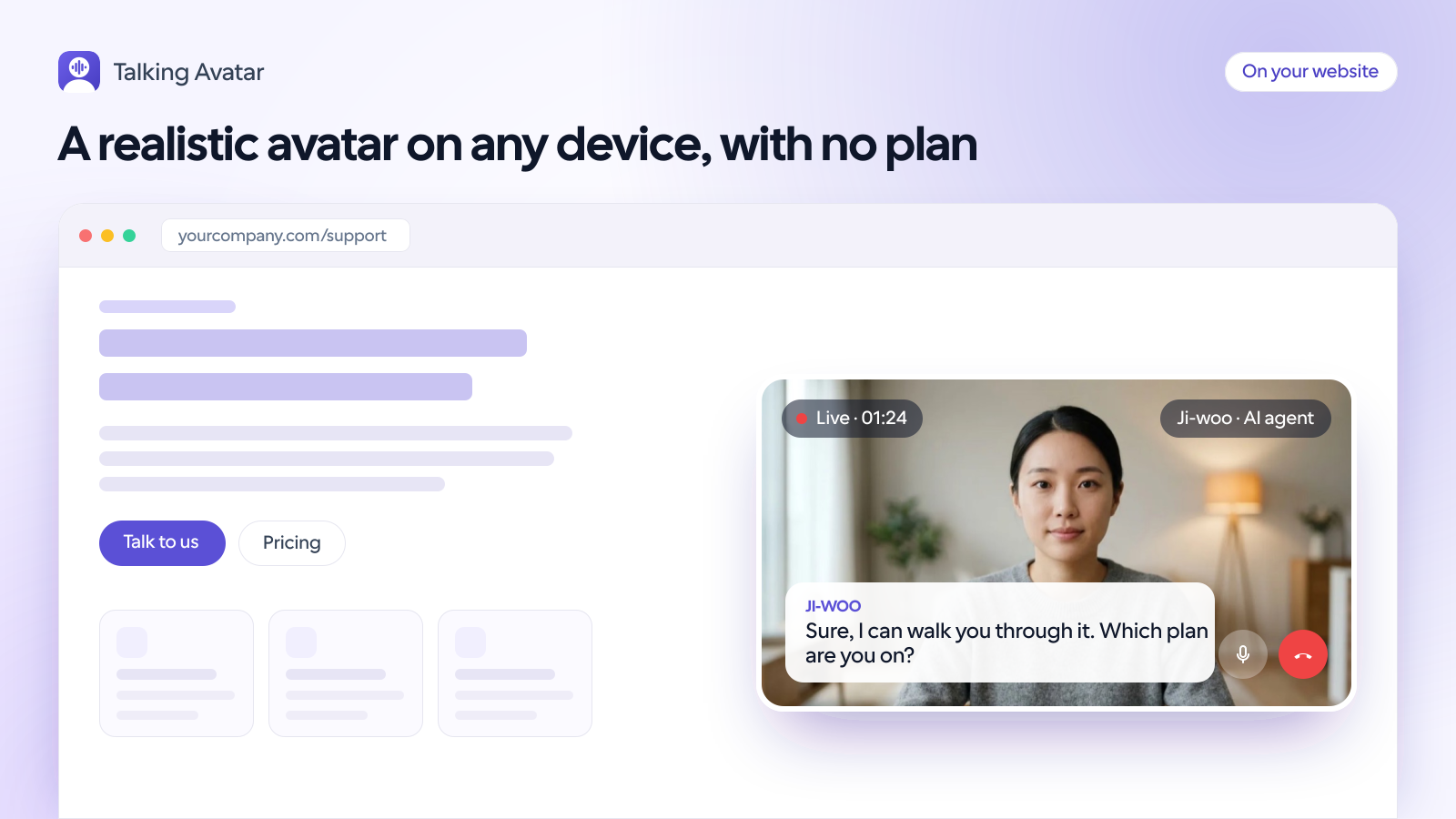
A realistic avatar on any device, with no plan
Talk to a realistic avatar in your browser, then get an API key: $0.02 a minute billed per second, server-rendered video, no cap on sessions at once, and $1 of free credits (50 minutes) at sign-up.