 Talking Avatar
Comparison guide
TalkingHead vs Talking Avatar: Which three.js Talking Head to Use
By Mukul Munjal, Co-founder, Talking Avatar · LinkedIn
· Prices checked 30 October 2026
Talking Avatar publishes this comparison. Facts about TalkingHead come from its own website, docs and pricing page, and we say where it's the better fit.
Quick answer
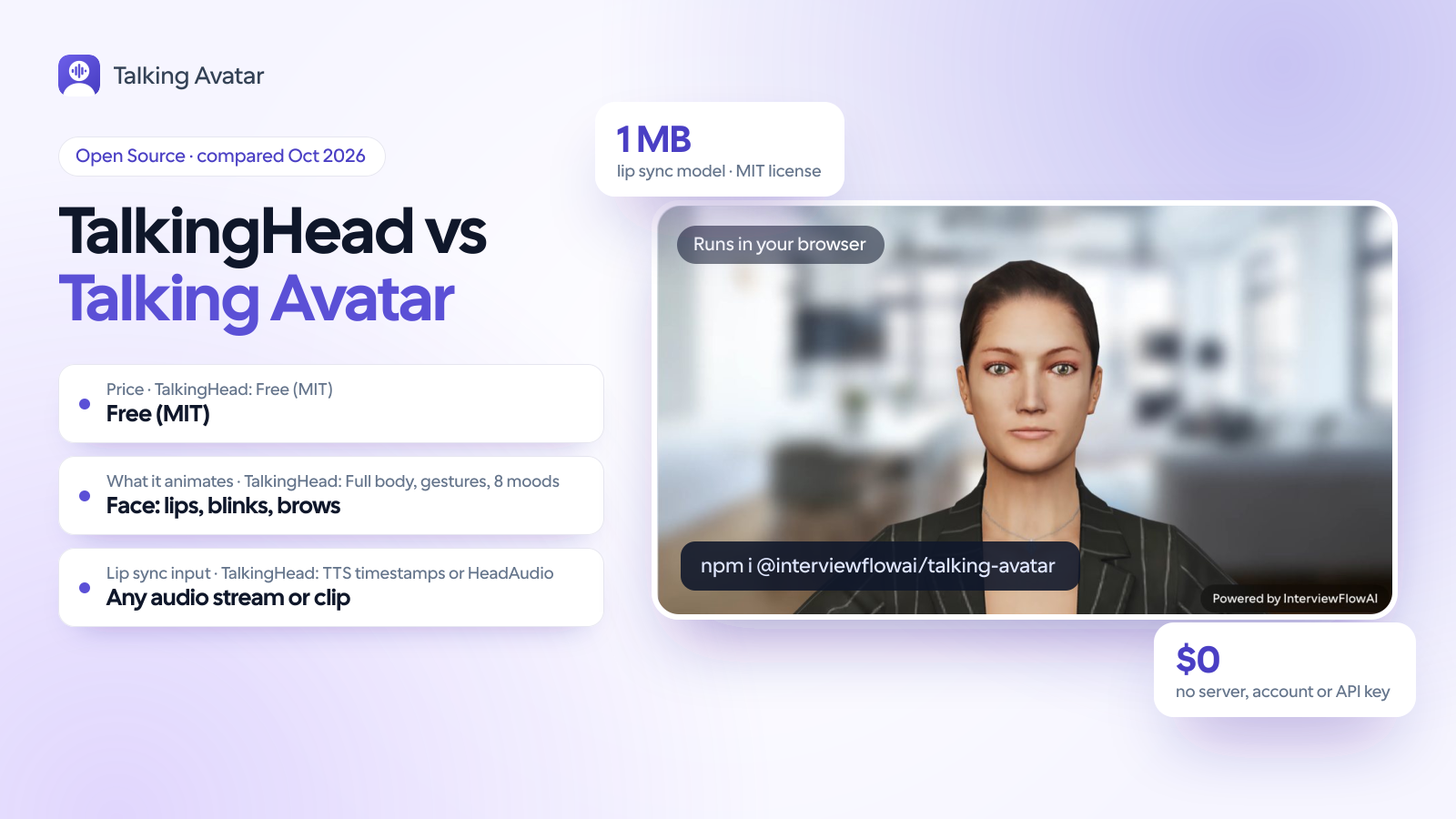
TalkingHead and Talking Avatar Open Source are both free, MIT-licensed three.js avatars, but they solve different problems. TalkingHead (v1.8.2, October 2026) animates a full body and times lip sync from TTS word timestamps; its HeadAudio add-on handles audio alone. Talking Avatar Open Source animates a face close-up (mouth, blinks and brows) from any audio stream, with a 1 MB neural model and about 10 KB of gzipped code.
60-second comparison
The decision at a glance
Pick TalkingHead when you want a whole character: hand gestures, moods, Mixamo animations, hair physics and lip sync in six languages from your TTS's word timings. It has 1,650 GitHub stars and shipped three releases in October 2026. Pick Talking Avatar Open Source when all you have is an audio stream, such as an OpenAI Realtime or LiveKit voice agent, and a face close-up is enough. It needs only the 15 Oculus visemes on your .glb, not a Mixamo rig. Both are MIT. Ours is new, and its model is a 1 MB download.
Choose Talking Avatar Open Source if…
- Your voice agent sends audio only (OpenAI Realtime, LiveKit, Pipecat), with no text or word timestamps.
- You want live audio in one call, attachStream(stream), without PCM chunking or viseme buffering.
- Your .glb has the 15 Oculus visemes but no Mixamo rig or full ARKit set.
- A face close-up is all the screen needs, and you'd rather not maintain body animation.
- You want a React component and TypeScript types in the package.
- You may later want a photorealistic face: Talking Avatar Realistic Avatars streams one for $0.02 a minute from the same voice agent.
Choose TalkingHead if…
- You need a full-body character with gestures, moods, poses or Mixamo animations.
- You control the TTS and can pass word timestamps, or want Azure visemes for 100+ languages.
- Your users speak German, French, Portuguese, Finnish or Lithuanian and you want mouth shapes for those languages.
- Page weight matters more to you than audio-only accuracy: about 73 KB with HeadAudio against our 1.05 MB.
- You want the larger project: 1,650 stars, examples for Google, Azure, ElevenLabs and OpenAI, and use in published research.
Feature comparison
| Feature | Talking Avatar Open Source | TalkingHead |
|---|---|---|
| What it animates | A face close-up: lips, natural blinks and brows. No head, gaze or body motion | A full body: lip sync, eye contact, head movement, 7 hand gestures, 8 moods, Mixamo FBX animations and dynamic bones |
| Lip sync input | Audio only: a MediaStream (WebRTC, microphone) or a clip (URL, ArrayBuffer, Blob) | Text plus word timestamps from your TTS (Google Cloud TTS by default); audio alone through the HeadAudio add-on |
| How mouth shapes are chosen | A causal neural network (about 260k parameters) on 10 ms log-mel frames, with 20 ms look-ahead | Language modules turn words into Oculus visemes; HeadAudio matches MFCC features against Gaussian prototypes |
| Languages | Trained on English; other languages keep their timing but use the nearest English mouth shape | EN, DE, FR, PT-BR, FI and LT modules in npm 1.8.2 (Bengali on GitHub); 100+ through Azure Speech visemes |
| Avatar requirements | Any .glb with the 15 Oculus viseme morph targets, or your own names mapped with morphTargets; ARKit mouth shapes optional | A Mixamo-compatible rig plus 52 ARKit and 15 Oculus viseme blend shapes |
| Avatar sources in the docs | Any pipeline that exports Oculus visemes; the mouth is tuned on Microsoft Rocketbox avatars | MPFB, Avaturn, VRoid Studio, Avatar SDK MetaPerson and Microsoft RocketBox (Ready Player Me dropped in v1.8.0) |
| Download, gzipped, without three.js | About 10 KB of code plus a 1.04 MB model, cached after the first load | About 47 KB core (220 KB raw) plus 2 to 6 KB per language; HeadAudio adds about 20 KB |
| Live audio streams | attachStream(stream) in one call; a 150 ms default delay lets the mouth move ahead of each sound | streamStart and streamAudio: you push 16-bit PCM chunks plus visemes, word timings or blend shapes |
| 3D scene | Its own transparent canvas with a portrait close-up camera | Its own scene and renderer with full, mid, upper and head views, or avatarOnly mode in your scene (experimental) |
| Voices | Any TTS (OpenAI, ElevenLabs, Azure, Cartesia), a voice agent or a microphone | Google Cloud TTS by default; ElevenLabs and Azure examples; HeadTTS runs Kokoro voices in the browser on WebGPU |
| Framework support | Framework-free class plus a React component, with TypeScript types | Plain JavaScript ES modules, from npm or a CDN import map |
| License | MIT (code and model) | MIT (its sample avatars carry their own terms, some non-commercial) |
| Latest release | 0.2.0 on 26 Oct 2026; first published 2 Oct 2026 | 1.8.2 on 25 Oct 2026; 1,650 GitHub stars |
What the browser downloads before the avatar speaks
Gzipped JavaScript and model files, measured from npm on 30 Oct 2026: TalkingHead 1.8.2, HeadAudio 1.0.0 and Talking Avatar Open Source 0.2.0. three.js (both need it) and the .glb avatar are left out. Our model is counted at its 1.04 MB file size because it barely compresses (968 KB gzipped).
- TalkingHead + English module53 KB
- TalkingHead + HeadAudio73 KB
- Talking Avatar Open Source1.05 MB
Text-driven or audio-driven: which lip sync does your app need?
TalkingHead's main path starts from text. You call speakText, the TTS returns audio with word timestamps, and a language module turns each word into Oculus visemes at the right moment. The catch: many voice agents never hand you text and timings. OpenAI Realtime, LiveKit and Pipecat agents send an audio stream. For that case TalkingHead's author wrote HeadAudio, which guesses visemes from sound; its README says "voice activity detection (VAD) and prediction accuracy are far from optimal, especially when the signal-to-noise ratio (SNR) is low", and that it trails the text-driven path. Talking Avatar Open Source only does audio. Its causal neural network picks the right mouth shape for 82% of 10 ms frames and closes the lips on 99% of p, b and m sounds, measured on 39 speakers held out from training. We haven't benchmarked the two side by side, so try your own audio in both demos.
Can TalkingHead lip sync an OpenAI Realtime or LiveKit voice agent?
Yes, with more wiring. TalkingHead's streaming mode (streamStart, then streamAudio) plays 16-bit PCM chunks you push to it and expects the lip sync data alongside: visemes, word timings or blend shapes. Its README says the calling app must handle synchronization and buffering, and that it handles one stream at a time. To lip sync from sound alone you add HeadAudio, which the author demonstrates with OpenAI Realtime over WebRTC. Talking Avatar Open Source takes the MediaStream itself. In a WebRTC app, pc.ontrack hands event.streams[0] to attachStream, and the SDK plays the audio, delays it by 150 ms by default so the mouth can move into each sound on time, and animates the face. Lower streamDelayMs for less delay at the cost of rougher lip sync. Neither library runs the conversation: you still bring the LLM, the voice and the turn-taking.
What avatar does each one need, now that Ready Player Me is gone?
TalkingHead animates the whole skeleton, so its README asks for a Mixamo-compatible rig plus 52 ARKit and 15 Oculus viseme blend shapes. Many projects got those from Ready Player Me, whose services went offline on 31 January 2026 after Netflix bought the company. TalkingHead v1.8.0 (22 October 2026) replaced the defunct Ready Player Me URLs with a bundled sample and now lists MPFB for Blender, Avaturn, VRoid Studio, Avatar SDK's MetaPerson Creator and Microsoft RocketBox, with a new retargeter for each creator's skeleton quirks. RocketBox characters need re-rigging first, for example in Mixamo. Talking Avatar Open Source lists no skeleton requirement, only the 15 viseme morph targets; ARKit mouth shapes are optional and make the lips rounder and firmer. If your avatar names its shapes differently, the morphTargets option maps them. Any avatar that works in TalkingHead already has the shapes our SDK reads.
How much does each one add to page weight?
Both need three.js, so leave it out. TalkingHead 1.8.2's core module is 220 KB raw and about 47 KB gzipped. Language modules load only if you list them in lipsyncModules (the default is English, Finnish and Lithuanian) and weigh 2 to 6 KB each, English being the largest. HeadAudio 1.0.0 adds about 20 KB: a 4 KB worklet, a 13 KB model and a 2 KB wrapper. Talking Avatar Open Source has the opposite shape: about 10 KB of gzipped code, then a 1.04 MB neural model that the browser caches after the first visit. On a cold load that is about 1 MB more than TalkingHead with HeadAudio, which you'll notice on a phone connection. While audio plays, the SDK's README measures about 2% of one CPU core on an Apple M5 Pro and says to plan for two to three times that on low-end laptops.
Full body or a face close-up: which fits your product?
Decide by what's on screen. A guide or tutor who walks, points and reacts needs TalkingHead's seven built-in hand gestures (thumbup and shrug among them), its eight moods and Mixamo animations. Talking Avatar Open Source is built for the close-up: its camera frames the head and neck, and the mouth, blinks and brows move, following whether the avatar is speaking, listening or thinking. That close-up suits a voice agent window, a support widget or an interview screen, where the voice carries the conversation. TalkingHead's camera views (full, mid, upper and head) cover both layouts. If you want a photorealistic person rather than a 3D model, that's a separate product of ours: Talking Avatar Realistic Avatars streams ready-made realistic avatars for $0.02 a minute.
Is TalkingHead free for commercial use?
The code is. TalkingHead and HeadAudio are MIT-licensed, as is Talking Avatar Open Source, so licensing isn't a reason to choose between them. The avatars are where commercial projects get caught. TalkingHead's sample brunette.glb was made at Ready Player Me and is licensed CC BY-NC 4.0, so it's for non-commercial use; its Avaturn and VRoid samples are also marked non-commercial, while the MPFB sample is CC0. The README warns that many commercial avatar products can't be used in public web apps, where the .glb is effectively downloadable. Check the terms of whatever model you ship. Microsoft RocketBox characters are MIT-licensed and come with ARKit and Oculus shapes, which is why our demo uses them.
When to choose TalkingHead
Where TalkingHead is the better fit
TalkingHead is the better fit when the avatar has to do more than talk: a full body with gestures, moods and Mixamo animations, and a 3D scene it can manage for you. It has the longer track record too, including use in published research. And if you control the TTS and can get word timestamps, its mouth follows the TTS's own timing while your users skip our 1 MB model download.
Good to know about Talking Avatar Open Source
- Talking Avatar Open Source's model is trained on English. Other languages keep good timing but use the nearest English mouth shape.
Switching from TalkingHead
Most TalkingHead avatars already carry the 15 Oculus visemes that Talking Avatar Open Source reads, so the .glb comes across unchanged. The work is in the audio path.
- Load your avatar in the open-source 3D demo (by URL or upload) and play a sample voice to check the mouth before you change code.
- Install the SDK next to three.js: npm install @interviewflowai/talking-avatar three.
- Create new TalkingAvatar({ container, avatarUrl }) with the same .glb; the viseme_* morph targets and any ARKit mouth shapes are picked up by name.
- Replace speakText, or the streamStart and streamAudio pipeline, with attachStream(stream) for live audio or speak(clip) for files, and delete the word-timestamp and viseme plumbing.
- Remove gesture, mood and playAnimation calls; keep TalkingHead for any scene that still needs a full body.
- Copy viseme-model.bin into your static files and set modelUrl, so production doesn't depend on jsDelivr.
Methodology
How we evaluated this comparison
Pricing and features come from each vendor's own website, documentation or source code, checked in October 2026 and dated on this page. Where a vendor doesn't publish something, we say so rather than guess. We haven't run paid trials of every product. We built Talking Avatar, so we name what each competitor does better and who should choose it instead.

About me
Mukul Munjal
Co-founder, Talking Avatar
I'm Mukul Munjal, co-founder of Talking Avatar. I have 7 years of experience in engineering, 3 of them building voice agents, and I handle the optimisation of our voice agents. We built Talking Avatar to give our own AI interviewers a face.
Frequently asked questions
What is TalkingHead (Talking Head 3D)?
TalkingHead, also called Talking Head (3D), is an MIT-licensed JavaScript class by met4citizen that renders a full-body 3D avatar in the browser with three.js and lip syncs it in real time. It's on npm as @met4citizen/talkinghead (1.8.2, 25 October 2026). Lip sync comes from TTS word timestamps through language modules, or from audio alone through its HeadAudio add-on.
Can TalkingHead lip sync from audio without text?
Yes, through HeadAudio, a separate MIT audio worklet by the same author that detects the 15 Oculus visemes from sound. It reached 1.0.0 on 22 October 2026 and weighs about 20 KB gzipped with its model. Its README says accuracy is far from optimal on noisy audio and below the text-driven path. Talking Avatar Open Source is audio-only by design and uses a 1 MB neural model instead.
Does TalkingHead still use Ready Player Me avatars?
No. Ready Player Me's services went offline on 31 January 2026, and TalkingHead v1.8.0 (22 October 2026) replaced the defunct Ready Player Me URLs with a local sample avatar. Its README now points to MPFB, Avaturn, VRoid Studio, Avatar SDK's MetaPerson Creator and Microsoft RocketBox. Avatar SDK notes that Ready Player Me .glb files you already downloaded keep working.
Can I use my TalkingHead avatar with Talking Avatar Open Source?
Yes. TalkingHead requires the 15 Oculus viseme blend shapes named viseme_sil to viseme_U, which are what Talking Avatar Open Source reads, and it uses ARKit mouth shapes when they're present. The rig and the body are ignored: the camera frames the face, and only the mouth, blinks and brows move. Try your file in the 3D demo before you change any code.
Is TalkingHead free for commercial use?
The code is: TalkingHead and HeadAudio are MIT-licensed, like Talking Avatar Open Source. Check the avatar separately. TalkingHead's sample brunette.glb is CC BY-NC 4.0, so non-commercial only, and many commercial avatar creators restrict use in public web apps, as its README warns.
Which is more accurate on audio-only input?
We haven't run a head-to-head test, so we won't claim a winner. Talking Avatar Open Source reports 82% of 10 ms frames correct and 99% lip closure on p, b and m across 39 held-out speakers, on speech passed through the Opus codec. HeadAudio's README calls its accuracy far from optimal on noisy audio. Play one clip through both demos.
Is there a three.js talking head that runs without a server?
Both of these. TalkingHead and Talking Avatar Open Source render and lip sync in the browser with three.js, with no GPU server. TalkingHead's default text path calls a TTS service such as Google Cloud TTS, which needs an API key and, its README advises, a proxy in production. Talking Avatar Open Source needs no key at all: it animates whatever audio you give it.
Test your TalkingHead avatar in the 3D demo
Upload the same .glb or paste its URL, then play a sample voice, an audio file or your microphone. It runs in your browser, free under MIT, with no account or API key. If the mouth looks right, the integration is two calls.