 Talking Avatar
Comparison guide
Mascot Bot Pricing 2026: Plans, Overage and a Free 3D Alternative
By Mukul Munjal, Co-founder, Talking Avatar · LinkedIn
· Prices checked 30 October 2026
Talking Avatar publishes this comparison. Facts about Mascot Bot come from its own website, docs and pricing page, and we say where it's the better fit.
Quick answer
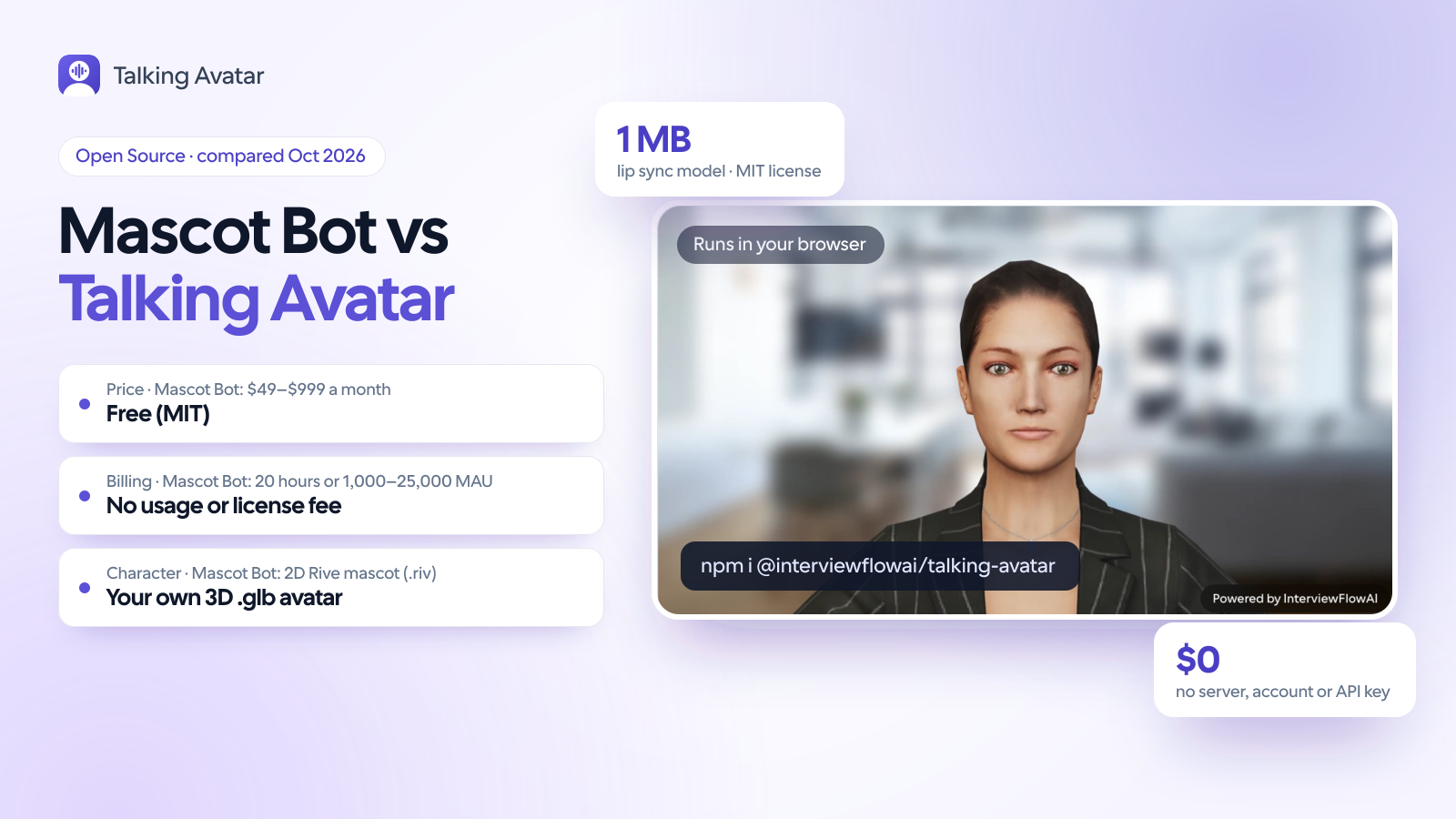
As of 30 October 2026, Mascot Bot costs $49 a month for 20 hours of lip-synced speech ($2.99 per extra hour), or $99, $299 and $999 a month for 1,000, 5,000 and 25,000 monthly active users, then $0.12, $0.07 and $0.05 per extra user, with 20% off yearly billing. It animates 2D Rive mascots. Talking Avatar Open Source animates your own 3D .glb avatar for free (MIT).
60-second comparison
The decision at a glance
Mascot Bot and Talking Avatar Open Source both put a lip-synced face on a voice agent without streaming video, and both work out mouth shapes from the audio on the user's device. They split on the art and the business model. Mascot Bot is a paid, keyed service for 2D Rive mascots, from $49 a month, with ready-made characters, no-code hosting and a design studio. Talking Avatar Open Source is a free, MIT-licensed SDK for your own 3D .glb avatar that needs no account and nothing from us while it runs.
Choose Talking Avatar Open Source if…
- Your character is a 3D .glb model, human or stylized, with the 15 Oculus visemes (or mouth morphs you can map).
- You want no API key, license check or usage meter between your page and the user, and the audio never leaving the browser.
- You want the cost to stay at $0 as users grow: MIT, with no per-user or per-hour fee.
- You want published accuracy: 82% of frames and 99% of p/b/m closures on 39 held-out speakers.
- Your agent runs on LiveKit, Daily/Pipecat or another WebRTC stack and you can pass its MediaStream to attachStream().
Choose Mascot Bot if…
- Your character is a flat 2D brand mascot and you want Rive's small files and designer-made animation.
- You want a ready-made mascot today, or a studio (Joyrive) to design one for you.
- You want no-code hosting or an embeddable widget instead of writing code.
- You use ElevenLabs Conversational AI or Gemini Live and want a starter app that already wires it up.
- You need vendor support and SLAs, which Mascot Bot sells on its Enterprise plan.
Feature comparison
| Feature | Talking Avatar Open Source | Mascot Bot |
|---|---|---|
| Character | Your 3D .glb (human or stylized) with the 15 Oculus viseme morph targets | 2D Rive character (.riv); Mascot Bot quotes 50–200 KB per file |
| Where characters come from | A female and a male avatar built in (MIT-licensed Microsoft Rocketbox), or bring your own .glb | Ready-made mascots from its Avatars API, or a custom one from Joyrive (price not published) |
| What moves | Mouth, natural blinks and brows, framed as a face close-up | Mouth visemes plus is_speaking and stress inputs; anything else your Rive state machine animates |
| Lip-sync input | Audio only: a MediaStream or a clip (URL, ArrayBuffer, Blob) | Audio only: 16 kHz mono buffers, the microphone or a tapped MediaStream |
| Timing | A mouth shape every 10 ms with 20 ms look-ahead; streams play 150 ms late (adjustable) | A viseme every 10 ms; vendor claims under 10 ms latency and 120 FPS rendering |
| Published accuracy | 82% of 10 ms frames, 99% of p/b/m lip closures (39 held-out speakers, Opus codec) | Not published |
| Runtime | Plain JavaScript: about 10 KB gzipped code plus a 1 MB model, about 2% of one CPU core while speaking | WebAssembly runtime fetched from Mascot Bot's edge at start-up; model size not published |
| Network while running | None of its own; the audio never leaves the page | Licensing, model delivery and usage metering (audio stays on the device, per Mascot Bot) |
| Account and keys | None: public npm package, no API key | API key required; SDK installs from a private npm registry; production keys work only on allow-listed domains |
| SDKs | Framework-free class and a React component, with TypeScript types | @mascotbot/core (framework-agnostic) and @mascotbot/react |
| Voice providers | Any MediaStream or clip: OpenAI Realtime, LiveKit, Daily/Pipecat, ElevenLabs or any TTS | Guides and templates for ElevenLabs Conversational AI, Gemini Live and OpenAI Realtime |
| No-code option | An npm SDK for developers; Voice Agents are our no-code option (realistic avatars) | Yes: no-code hosting and embeddable widgets |
| Price (30 Oct 2026) | Free (MIT): no per-user, per-hour or license fee | $49/mo (20 h, then $2.99/h); $99, $299 or $999/mo for 1,000, 5,000 or 25,000 MAU; Enterprise quoted; 20% off yearly |
| Source code | Open source on GitHub (MIT) | Closed SDK; example apps on GitHub, several MIT-licensed |
Monthly lip-sync cost: 2,000 users, 10 minutes of avatar speech each
333 hours of speech a month. Mascot Bot list prices from mascot.bot on 30 Oct 2026, billed monthly: plan fee plus published overage (Starter $2.99 per extra hour, Launch $0.12 per extra active user). Talking Avatar Open Source has no license or usage fee; hosting and your voice provider aren't counted.
- Talking Avatar Open Source$0
- Mascot Bot Launch$219
- Mascot Bot Growth$299
- Mascot Bot Starter$986
- Mascot Bot Scale$999
How much does Mascot Bot cost?
Mascot Bot has five plans, as of 30 October 2026. Starter is $49 a month for 20 hours of lip-synced speech, metered by processed speech time, then $2.99 per extra hour. Launch ($99), Growth ($299) and Scale ($999) include 1,000, 5,000 and 25,000 monthly active users, each with unlimited lip-sync minutes, then $0.12, $0.07 and $0.05 per extra user. Enterprise is quoted. Paying yearly takes 20% off every tier. Starter works out to about 4 cents a minute ($49 for 1,200 minutes). Past about 37 hours of speech a month, Launch costs less if you have fewer than 1,000 active users. Growth beats Launch above roughly 2,670 users, and Scale beats Growth above 15,000. A worked case: 2,000 users who each hear 10 minutes of avatar speech a month is 333 hours. That's $219 on Launch ($99 plus 1,000 extra users at $0.12), $299 on Growth and $986 on Starter. Talking Avatar Open Source costs nothing at any volume; you pay only to host its files. If you'd rather show a photorealistic person, our separate hosted Realistic Avatars cost $0.02 a minute: $400 for those 333 hours.
Should your character be a 2D Rive mascot or a 3D avatar?
This decides the comparison before price does. Mascot Bot is built on Rive, the vector animation tool many apps use for flat, cartoon brand characters. A designer draws and animates the character, the file stays small, and its state machine can hold any reaction or gesture the designer adds; Mascot Bot drives the mouth plus two inputs, is_speaking and stress. Talking Avatar Open Source drives 3D .glb models through three.js. It suits human or stylized 3D heads, such as avatars from a selfie creator like Avatar SDK (MetaPerson), a Blender model or an old Ready Player Me export, and frames the face in close-up. It animates the mouth, blinks and brows, and leaves the head and body still. A .riv file can't become a .glb, or the other way round. Pick the format that matches the art you have, or the art you plan to commission.
How does the lip sync work in each?
Both listen to the audio, not the text, so both work with any voice. Mascot Bot's SDK swaps your API key with its edge worker at start-up for a short-lived license and a WebAssembly runtime, then infers a viseme for every 10 ms frame on the device. Mascot Bot says the audio isn't sent to its servers. It can also run once on a recorded line and save the result as a JSON timeline to replay later. Our 1 MB model is a small causal network in plain JavaScript, with no WebAssembly or ML runtime. It names a mouth shape every 10 ms, looking 20 ms ahead, and live streams play 150 ms late so the lips move into each sound on time. On 39 speakers held out from training, through the Opus codec a WebRTC call uses, it picks the right shape for 82% of frames and closes the lips on 99% of p, b and m sounds. Mascot Bot doesn't publish accuracy figures, so test both with your own agent's voice.
What does it take to ship each one?
Mascot Bot needs an account from the first line of code. Its SDK installs from a private npm registry, with your mascot_ key as the token. Development keys work on localhost and private networks without billing; production keys work only on domains you allow-list, and usage is metered from the browser. The SDK won't start without WebAssembly and crypto.subtle, and its Rive renderer needs WebGL2 (Safari 17 or later). In return you get a React provider and hooks, a framework-free core and starter apps for ElevenLabs, Gemini Live and OpenAI Realtime. Talking Avatar Open Source is a public npm package with no key. Create it with a container and a .glb URL, then call attachStream() with the agent's MediaStream or speak() with a clip. It plays the audio itself, so you pass it the stream instead of an audio element. The model loads from jsDelivr by default; serve it from your own domain and nothing at runtime depends on us. It needs a .glb with the 15 Oculus viseme morph targets; other mouth morph names can be mapped with the morphTargets option.
Is there a free way to lip sync a Rive character?
Yes, if you wire it yourself. A Rive state machine can take a number input, and Rive's web runtime lets your code set it every frame. Feed it from a free viseme detector. wawa-lipsync (MIT, about 2.6 KB gzipped) scores the 15 Oculus visemes from an audio element or the microphone with hand-tuned rules. HeadAudio (MIT) detects them in an AudioWorklet with a 14 KB model, and its README warns that accuracy drops on noisy audio. For recorded dialogue, Rhubarb Lip Sync writes a 2D mouth-shape timeline offline. None of these gets you Mascot Bot's result out of the box. You map visemes to your mouth drawings, smooth the changes between them and handle streaming audio yourself, and that glue is much of what its plans pay for. Talking Avatar Open Source renders 3D .glb avatars, so for a 2D mascot one of these routes is the place to start.
When to choose Mascot Bot
Where Mascot Bot is the better fit
Choose Mascot Bot if your character is a flat 2D mascot. Rive is the better medium for a Duolingo-style brand character: a designer controls every pose, the files are tiny, and its state machine can animate any reaction or gesture the designer draws. Mascot Bot also offers ready-made mascots, a studio (Joyrive) to design yours, no-code hosting, starter templates for ElevenLabs, Gemini Live and OpenAI Realtime, and an Enterprise plan with SLAs.
Good to know about Talking Avatar Open Source
- Talking Avatar Open Source's model is trained on English. Other languages keep good timing but use the nearest English mouth shape.
Switching from Mascot Bot
Switching is mostly an art job. A Rive character and a .glb model aren't interchangeable, but your voice stack carries over as it is.
- Get a 3D .glb of your character with the 15 Oculus viseme morph targets (viseme_sil to viseme_U). If its mouth shapes have other names, map them with the morphTargets option.
- Install the SDK from public npm (npm install @interviewflowai/talking-avatar) and remove the Mascot Bot registry token and API key from your build.
- Replace <MascotProvider> and the Mascot component with <TalkingAvatarView avatarUrl={…} stream={…} /> in React, or new TalkingAvatar({ container, avatarUrl }) in plain JavaScript.
- Pass the agent's audio to attachStream() instead of playing it in an audio element, or a recorded clip to speak(). The SDK plays the audio itself.
- Before launch, serve viseme-model.bin from your own domain (the modelUrl option) instead of jsDelivr.
Methodology
How we evaluated this comparison
Pricing and features come from each vendor's own website, documentation or source code, checked in October 2026 and dated on this page. Where a vendor doesn't publish something, we say so rather than guess. We haven't run paid trials of every product. We built Talking Avatar, so we name what each competitor does better and who should choose it instead.
About me
Mukul Munjal
Co-founder, Talking Avatar
I'm Mukul Munjal, co-founder of Talking Avatar. I have 7 years of experience in engineering, 3 of them building voice agents, and I handle the optimisation of our voice agents. We built Talking Avatar to give our own AI interviewers a face.
Frequently asked questions
How much does Mascot Bot cost?
Mascot Bot costs $49 a month for 20 hours of lip-synced speech on Starter, then $2.99 an hour, as of 30 October 2026. Plans by monthly active users are $99 (1,000 users), $299 (5,000) and $999 (25,000), then $0.12, $0.07 and $0.05 per extra user. Enterprise is quoted, and yearly billing takes 20% off every tier.
Does Mascot Bot have a free plan or free trial?
Mascot Bot doesn't publish a free plan or free trial as of 30 October 2026. Its docs say development keys, which work only on localhost and private networks, run without billing, so you can build and test before you pay. Production keys on your own domains need a paid plan. Talking Avatar Open Source is free in production too, under the MIT license.
Which Mascot Bot plan is cheapest?
Starter is cheapest below about 37 hours of avatar speech a month. Above that, Launch at $99 wins if you have fewer than 1,000 active users. Growth beats Launch above roughly 2,670 users, and Scale beats Growth above 15,000. For example, 2,000 users hearing 10 minutes each costs $219 on Launch and $986 on Starter, before the yearly discount.
Is Talking Avatar a free alternative to Mascot Bot?
For 3D characters, yes. Talking Avatar Open Source is MIT-licensed, needs no account or API key, and lip syncs a .glb avatar in the browser from any audio. It isn't a drop-in swap, because it renders 3D .glb models rather than Rive files; ready-made mascots and no-code hosting are Mascot Bot's. For a free 2D route, connect wawa-lipsync or HeadAudio to a Rive state machine yourself.
Does Mascot Bot send users' audio to its servers?
No, according to Mascot Bot. Its SDK infers visemes on the device and uses the network for licensing, delivering the model and runtime, and usage metering. Talking Avatar Open Source has no license check or metering: apart from the model (from jsDelivr unless you host it) and your .glb, it fetches nothing, and the audio never leaves the page.
Do both work with ElevenLabs, Gemini Live and OpenAI Realtime?
Yes. Both lip sync from audio, so any voice provider works. Mascot Bot has guides and starter apps for ElevenLabs Conversational AI, Gemini Live and OpenAI Realtime. Talking Avatar Open Source takes the agent's MediaStream through attachStream(), with documented snippets for OpenAI Realtime over WebRTC, LiveKit and Daily (Pipecat), or a TTS clip through speak().
Hear a 3D avatar lip sync your agent's voice
Open the 3D demo, pick a sample voice or talk into your mic, and watch the 1 MB model move the mouth. Then npm install, point it at your .glb and call attachStream(). MIT, no API key, no per-user fee.